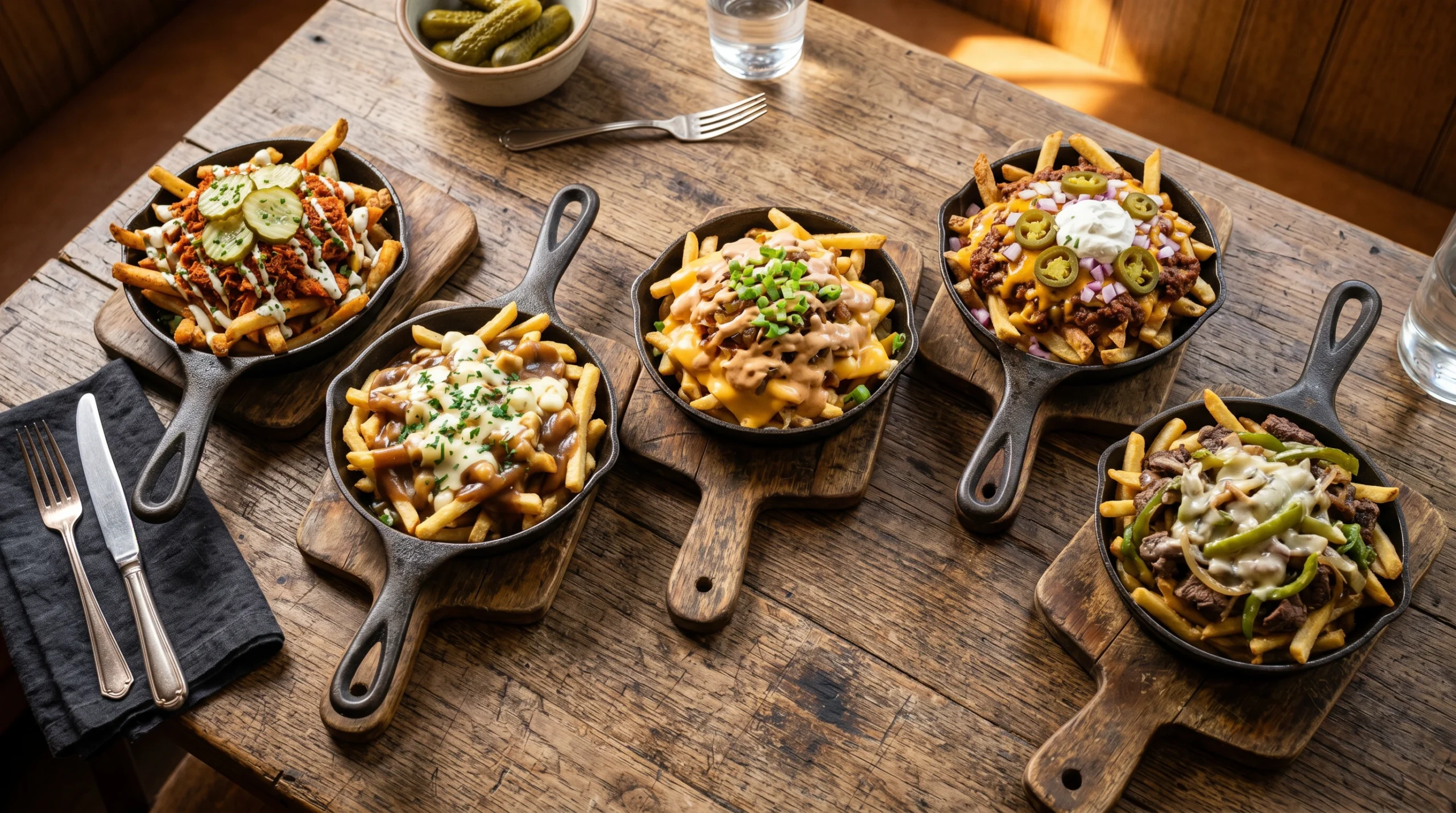
America has never agreed on much, but loaded fries are non-negotiable. Walk into any late-night diner in New Jersey, any food truck festival in Los Angeles, any lakefront dive bar in Chicago, and you will find some version of fries piled impossibly high with toppings that vary wildly by zip code. Regional loaded fries are not a trend. They are a culinary fingerprint, each city’s flavor identity pressed into a bed of potatoes.
The loaded fry movement has exploded in the last five years, with street food vendors and home cooks alike discovering that the right toppings can transform a humble potato into something worth traveling for. This guide, part of our Ultimate Guide to Making Street Food at Home, breaks down five iconic regional American loaded fry styles, the technique behind each, and the details that separate the authentic versions from lazy imitations.
Keywords covered: loaded fries recipe, animal style fries copycat, disco fries New Jersey, carne asada fries, chili cheese fries Texas, Nashville hot chicken fries, how to make crispy fries double fry, loaded fries toppings ideas, best street fries recipe.
The Non-Negotiable Foundation: Fries That Actually Stay Crispy
Why Double-Frying Is the Only Method That Works
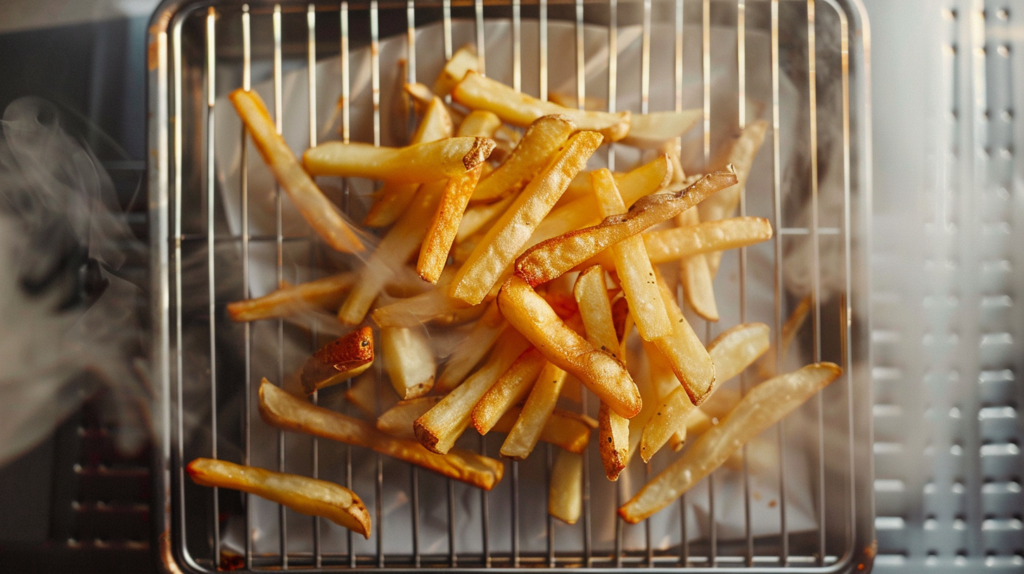
Soggy fries cannot be rescued by great toppings. The difference between restaurant-quality loaded fries and a disappointing home version almost always comes down to the double fry. Cut russet potatoes into uniform 1/4-inch batons. Soak in cold water for 30 minutes to draw out surface starch. Dry completely. First fry at 325F for 4 to 5 minutes until pale and cooked through. Rest on a wire rack for 15 minutes minimum. Second fry at 375F for 2 to 3 minutes until deeply golden and crackling. Season immediately with salt while wet with oil.
Potato Variety and Cut: What the Pros Know
Russet potatoes have the highest starch content of any common variety, which translates directly into a crispier exterior. Waxy potatoes like Yukon Gold hold moisture and produce a softer fry that collapses under toppings. Uniform cut width matters because inconsistent batons fry at different rates, giving you a mix of overcooked thin pieces and undercooked thick ones. A mandoline or a steady hand and patience produce the consistency a loaded fry needs to hold up.
Style 1: West Coast Animal Style Fries (California)
The Secret to Real Caramelized Onions
Animal Style fries live or die on the caramelized onion. Most home cooks spend 10 minutes and get braised onions: soft, mild, nothing like the real thing. Proper caramelized onions take 40 to 45 minutes over medium-low heat with butter, ending up deep amber, almost jammy. Do not rush this. Make them three days ahead and refrigerate.
The In-N-Out Spread: Recreating the Sauce at Home
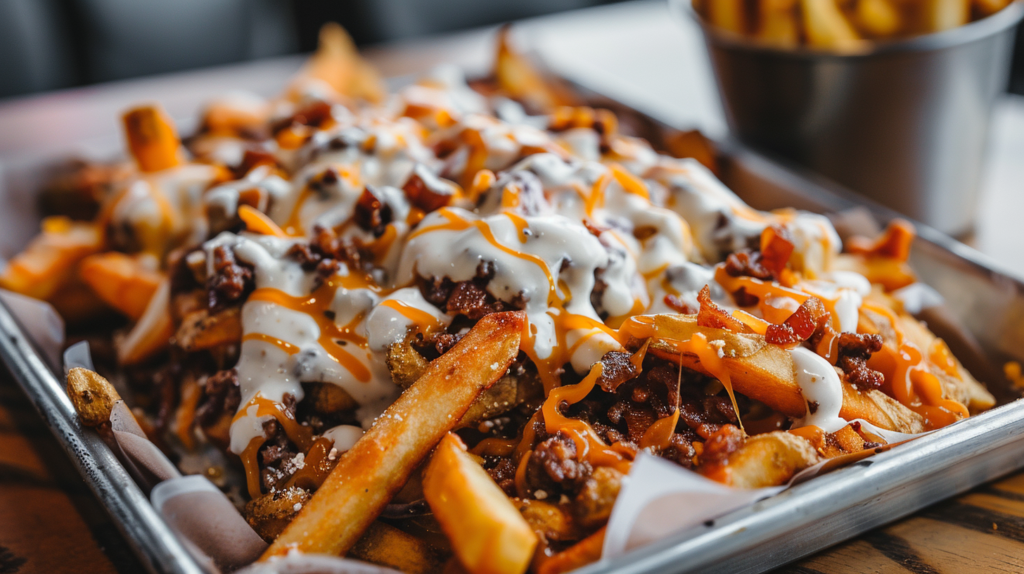
The spread is a Thousand Island variant: 1/2 cup mayo, 1/4 cup ketchup, 2 tablespoons sweet pickle relish, 1 teaspoon white vinegar, 1/2 teaspoon sugar. Whisk and chill for at least an hour. Assembly requires speed: fries from oil onto tray, two or three slices of American cheese laid flat (the heat does the melting), caramelized onions spooned over, spread drizzled across. Serve within 90 seconds. For more copycat sauces that pair with loaded fries, our Copycat Street Sauces guide covers six more iconic fast food sauces.
Style 2: New Jersey Disco Fries
What Makes Disco Fries Different from Poutine
New Jersey disco fries predate poutine in the American diner lexicon and differ in one critical way: mozzarella instead of cheese curds, and the specific crinkle-cut fry whose ridges trap gravy like a sponge. The gravy must be pourable, not thick. The cheese must be shredded low-moisture mozzarella, not cheddar, not cheese sauce. The result is a half-melted cheese state that is somehow better than either fully melted or fully solid.
Building the Perfect Brown Gravy from a Roux
Melt 3 tablespoons butter, add 3 tablespoons flour, whisk for 2 minutes until golden and nutty. Add 2 cups beef stock, 1 teaspoon Worcestershire sauce, 1/2 teaspoon garlic powder, salt and pepper. Simmer 8 minutes until it coats the back of a spoon. This roux technique is identical to what we use for the Beer Cheese Sauce in our Pretzels guide: learn the roux once and you can build any sauce-based topping.
Style 3: Texas Chili Cheese Fries
Why Texas Chili Is Always Beanless
In Texas, chili with beans is not chili. It is something else. The beanless version concentrates all flavor into the beef and dried chiles, producing a thick, glossy sauce that clings to fries rather than sliding off. The resulting chili is dense, deeply savory, and complex in a way that no 15-minute version achieves.
45-Minute Texas Chili: The Fast Version That Still Works
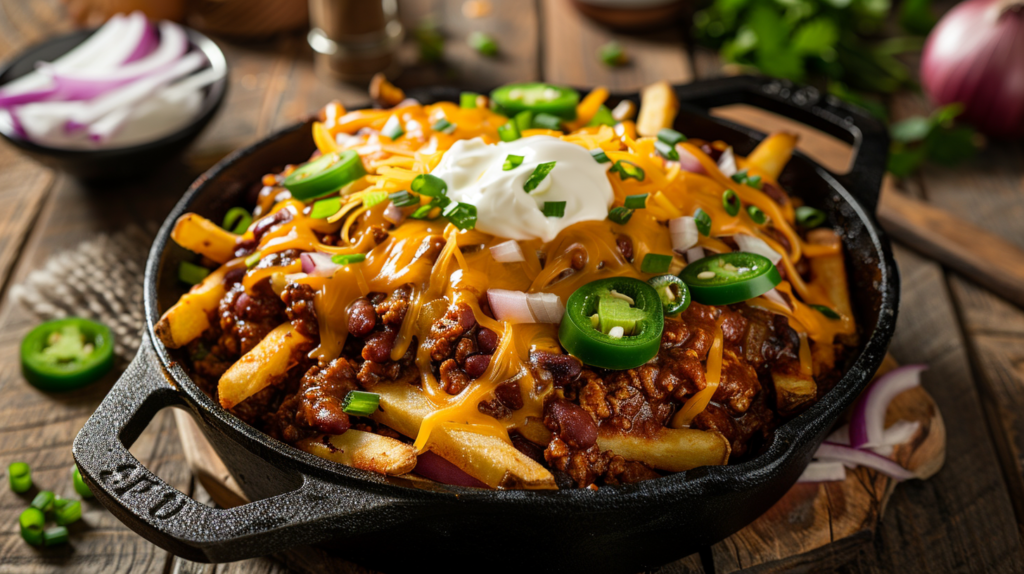
Brown 1 lb coarse-ground beef until genuinely browned in spots. Add 1 diced yellow onion, 4 minced garlic cloves, 2 tablespoons ancho chili powder, 1 tablespoon cumin, 1 teaspoon smoked paprika, 1 teaspoon oregano, a pinch of cayenne. Add 1 cup beef stock and 1 can crushed tomatoes. Simmer uncovered 30 minutes until thick and slightly glossy. Assembly: fries in a broad bowl, chili over, shredded sharp cheddar under the broiler for 90 seconds, then cold sour cream, raw white onion, and pickled jalapenos. The thermal contrast between hot chili and cold sour cream is the point.
Style 4: California Carne Asada Fries (San Diego)
The Carne Asada Marinade That Makes the Difference
Carne asada fries were born in San Diego’s taqueria culture and are a full meal disguised as a fry dish. The marinade: 1/4 cup orange juice, 2 tablespoons lime juice, 3 minced garlic cloves, 1 tablespoon soy sauce, 1 tablespoon olive oil, 1 teaspoon cumin, 1 teaspoon smoked paprika, fresh cilantro, salt and pepper. Marinate flank or skirt steak 2 to 4 hours.
How to Get the Char That Makes Carne Asada Worth It
Cook on the highest heat possible, a screaming-hot cast iron or grill, for 3 to 4 minutes per side. The hard char on the exterior is not optional: those caramelized bits are the flavor. Rest 5 minutes, slice thin against the grain. Assembly: fries, carne asada, melted cheddar or jack cheese, guacamole, sour cream, pico de gallo. Adding a scoop of esquite from our Mexican Street Corn guide turns this into a complete San Diego street food spread.
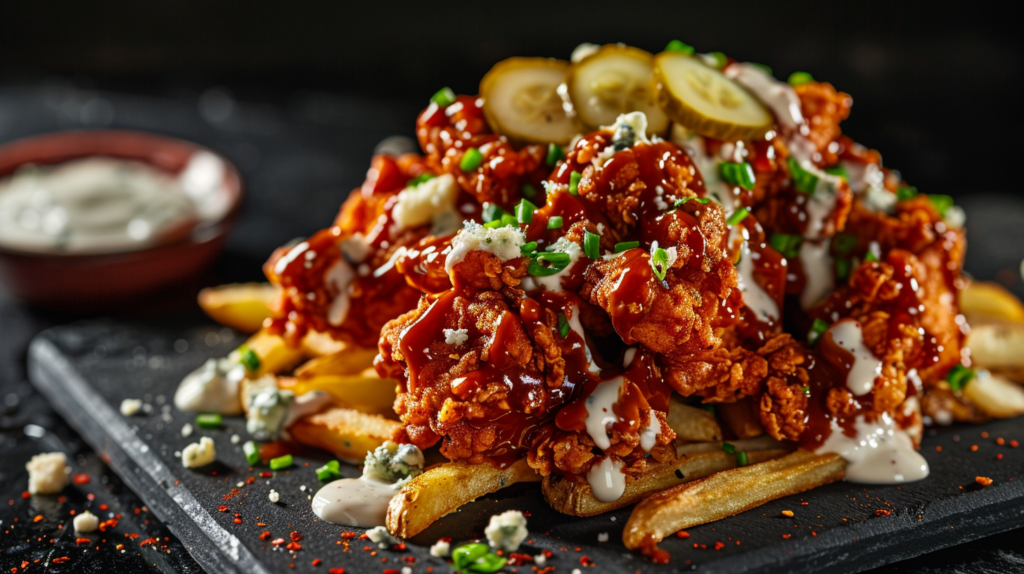
Style 5: Nashville Hot Chicken Fries
The Nashville Hot Sauce Formula
Melt 4 tablespoons butter. Whisk in 2 tablespoons cayenne, 1 tablespoon brown sugar, 1 teaspoon smoked paprika, 1 teaspoon garlic powder, 1/2 teaspoon salt. The brown sugar rounds the heat without sweetening it. Fry buttermilk-soaked, flour-dredged chicken thigh pieces at 350F for 6 to 7 minutes. Toss immediately in the hot sauce.
Why the Pickle and Ranch Are Not Optional
Nashville hot chicken without dill pickles and a cooling dairy element is just spicy chicken. The pickles’ acidity cuts through the fat. The ranch or blue cheese brings the temperature down and creates a contrast that makes every bite more interesting than the last. This is the same principle that makes cold toppings on hot nachos work. The late-night applications for this style are in our Late-Night Street Food guide.
The Three Universal Rules of Loaded Fries
Rule 1: Fries Go from Oil to Toppings in Under Two Minutes
Every minute a fried potato sits without toppings, steam escapes and the exterior loses crispiness. Get all toppings prepped and warm before the second fry goes in. Loaded fries are a dish that rewards preparation, not improvisation.
Rule 2: Temperature Contrast Is the Flavor Mechanism
Hot fries plus a cold element, sour cream, guacamole, fresh pico, creates a temperature interplay that makes every bite more interesting than uniform heat. This is not a garnish decision. It is a structural one.
Rule 3: Season Twice, Not Once
Season immediately after the second fry with fine salt while the fries are still wet with oil. Season again lightly after topping with flaky salt. The second salting wakes up all the flavors above the fry line and unifies the dish.
Related Articles in This Series
- The Ultimate Guide to Making Street Food at Home
- Easy Elotes (Mexican Street Corn) 4 Ways
- Korean Corn Dogs at Home: Crispy Cheesy Guide
- Vietnamese Banh Mi in 30 Minutes: Home Guide
- Homemade Soft Pretzels with Beer Cheese Sauce
- Authentic Jamaican Beef Patties from Scratch
- Late-Night Street Food Snacks Under 20 Minutes
- Copycat Raising Cane’s and Chick-fil-A Street Sauces