Walk through Myeongdong Market or Namdaemun in Seoul and you’ll smell them before you see them: Korean corn dogs (핫도그, hotdog), frying golden in giant vats of oil, their stretchy mozzarella cheese pulling dramatically as someone takes a first bite. That cheese pull, improbably long and impossibly satisfying, is why Korean corn dogs became the most replicated street food on social media in the 2020s.
But there’s a problem with most copycat recipes: they confuse the American corn dog (cornmeal batter, casual Americana) with the Korean corn dog (yeasted wheat dough, precise technique, multiple coating options). These are completely different foods that happen to share a skewer. This guide, part of our Ultimate Guide to Making Street Food at Home, gives you the real Korean version: all three coating variations, the batter science, and the sugar-finish ritual that makes every bite unforgettable.
Keywords covered: Korean corn dog recipe, hotdog Korean street food, gamja hotdog potato corn dog, mozzarella corn dog, yeast batter corn dog, ramen corn dog, Korean street snack at home, how to make Korean corn dog, 핫도그 recipe.
Why the Batter Changes Everything
The defining difference between an American and Korean corn dog is the batter. American corn dogs use a cornmeal-based batter that’s light, crumbly, and slightly sweet when fried. Korean corn dogs use a yeasted wheat flour dough, closer to a donut dough than a batter, that fries up chewy, with a distinct sweetness and a substantial texture that clings to fillings and coatings.
The yeast matters because it creates a slightly fermented flavor and a springy, bread-like interior that contrasts perfectly with the crunchy exterior coating. Without yeast (or its rest time), you get a dense, doughy result that tastes nothing like what you’d find in Seoul.
The Master Batter Recipe
- 1 3/4 cups (220g) all-purpose flour
- 2 teaspoons instant yeast (or active dry, bloomed first in warm water)
- 1 tablespoon sugar
- 1/2 teaspoon salt
- 3/4 cup (180ml) warm water (40C/105F, warm to the touch, not hot)
Mix flour, sugar, salt, and yeast in a wide, shallow bowl. Add warm water gradually, stirring until a thick, smooth batter forms. It should be dense: not pourable like pancake batter, but also not so stiff it doesn’t coat a skewer. Cover with plastic wrap and let rise in a warm spot for 45-60 minutes. The batter should increase in volume and look slightly bubbly on the surface.
Critical step: The bowl must be long and narrow enough that you can roll a skewer inside it. A loaf pan works perfectly. This rolling motion is how Korean street vendors coat their dogs evenly without using their hands.
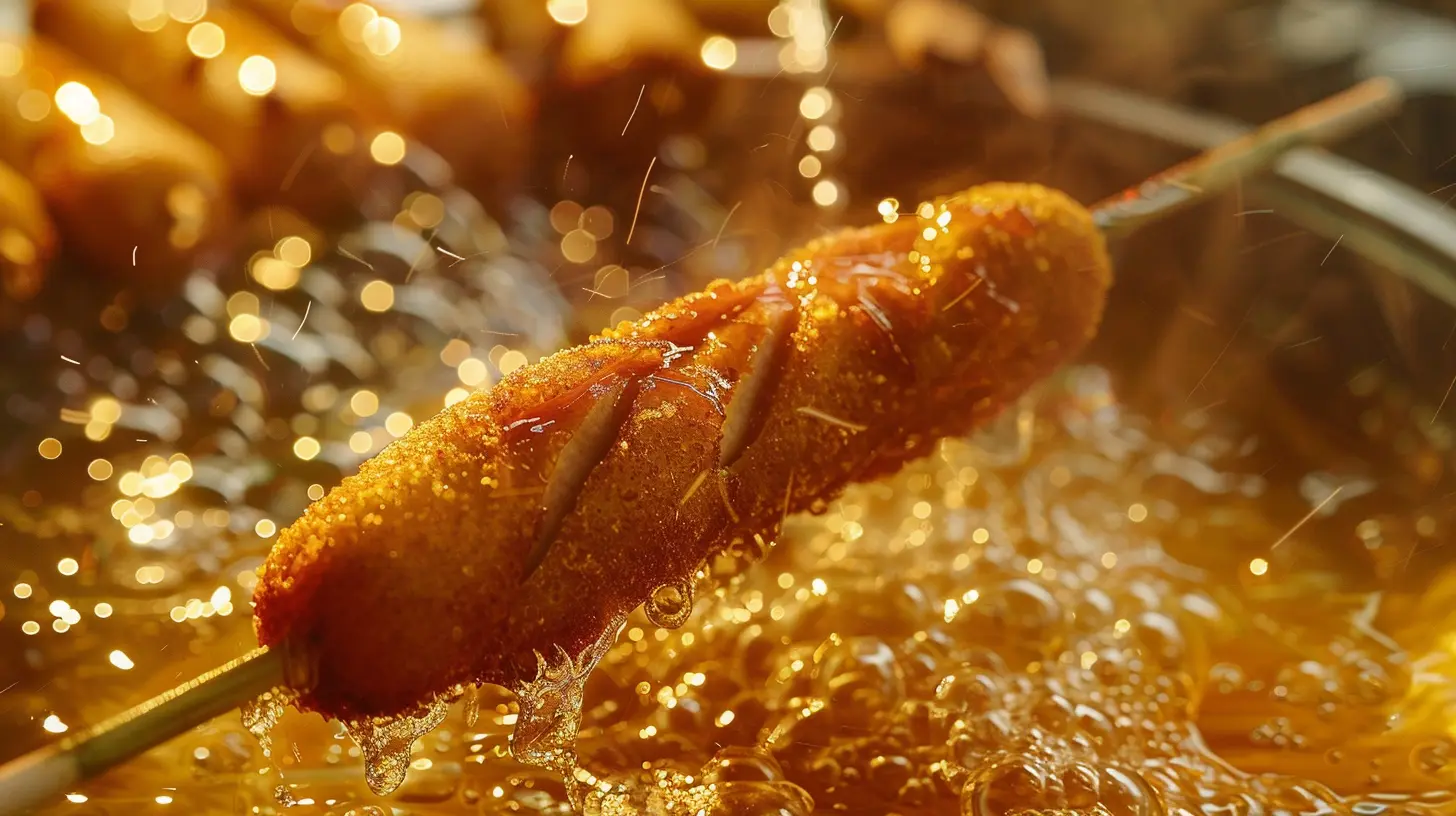
Midjourney Prompt: Korean corn dog 핫도그 frying in a deep pot of golden oil, yeasted batter coated sausage on a wooden skewer, surrounded by bubbling hot oil, Seoul street market Myeongdong background, dramatic steam, close-up macro food photography, warm amber tones, cinematic –ar 16:9 –v 6
The Three Coating Options
Coating 1: Classic Panko
The original and most widely available coating. After rolling in batter, immediately roll in a shallow tray of panko breadcrumbs, pressing gently so the crumbs adhere to every surface. Fry in 350F (175C) oil for 4-5 minutes, turning frequently for even browning. The panko creates a shatteringly crispy exterior that protects the chewy batter layer underneath. This coating works with any filling: cheese, sausage, or the combination of both.
Coating 2: Potato Cubes (Gamja Hotdog)
This is the Instagram version, studded with tiny potato cubes that fry golden and provide extra crunch in every bite. The technique requires a specific preparation: freeze raw, small-diced potatoes (about 1/2cm cubes) for at least 20 minutes before coating. Frozen cubes hold their shape better during frying and adhere more reliably to the batter. Dust the frozen cubes lightly with cornstarch before pressing them into the battered skewer.
Fry at a slightly lower temperature, 340F (170C), for 5-6 minutes. The potato cubes need more time than panko to cook through. The result is a dog with multiple textural dimensions: chewy dough, molten cheese, then small explosions of crispy potato with every bite. If you loved the textural complexity in our Street-Style Loaded Fries guide, this potato approach will feel familiar in the best way.
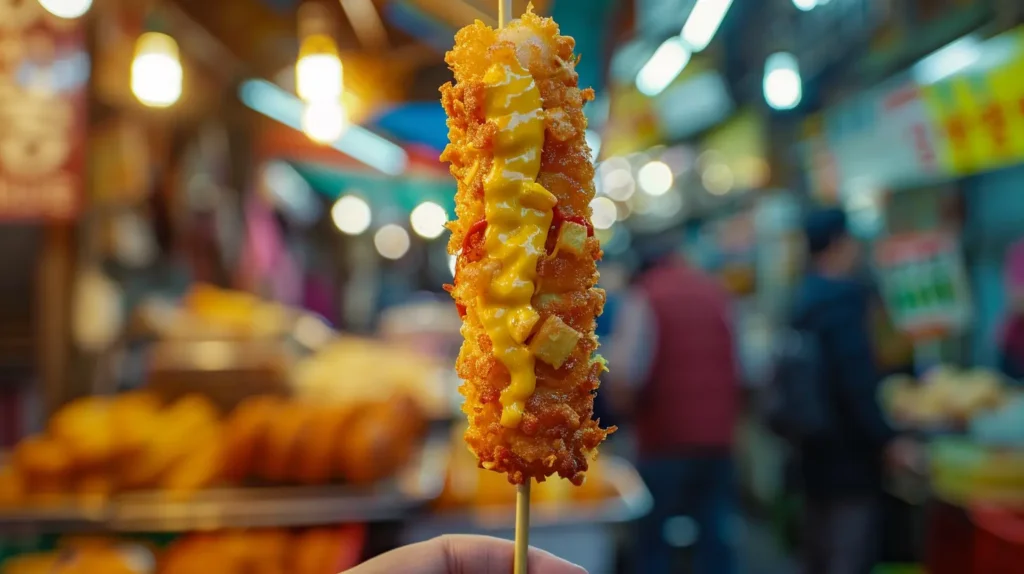
Midjourney Prompt: Gamja hotdog Korean corn dog coated in golden diced potato cubes, fresh out of the fryer on a wooden skewer, held up against a bright Seoul street market background, cheese pull visible, crispy exterior glistening, food photography overhead shot, vibrant colors –ar 16:9 –v 6
Coating 3: Crushed Ramen Noodles
The wildcard, and the one that surprises people most. Crush a packet of dry ramen noodles (uncooked) into rough, angular pieces about 1-2cm long. Press onto the battered skewer before frying. The ramen noodles fry up extraordinarily crunchy and add a slight savory, almost salty depth that pairs counterintuitively well with the sweet batter and molten cheese. Some vendors add the seasoning packet from the ramen to a dipping sauce on the side: strongly recommended.
Filling Combinations
All-Cheese: A full stick of low-moisture mozzarella on a skewer. This is the most dramatic option for the cheese pull. Use block mozzarella cut into 1/2-inch square logs: pre-shredded mozzarella contains anti-caking agents that prevent proper melting. Keep the cheese frozen until the moment you coat it.
Cheese + Sausage: Thread a hot dog sausage and a thick strip of mozzarella on the same skewer, alternating or side by side. The classic combination, savory salty sausage against the mild stretchy cheese. Frankfurt-style sausages work best; avoid anything too thin or it will shrink during frying and leave gaps in the filling.
Cheese + Rice Cake (Tteok): The most authentically Korean combination. Cylindrical rice cakes (tteok) have a chewy, almost sticky texture when heated that provides an additional textural layer unlike anything else. Find them in any Korean grocery, fresh or frozen.
The Sugar Ritual: The Detail Everyone Misses
Here is the step that turns a good Korean corn dog into a great one: immediately after removing from the oil, while still hot, roll the corn dog over a flat tray of granulated white sugar. The heat from the dog slightly caramelizes the sugar on contact, creating a delicate, barely-there sweet crust on the exterior.
This sweet-salty-savory combination is the signature of Korean corn dogs, what makes them distinctly Korean rather than just “corn dogs with better cheese.” Don’t skip it. It takes 3 seconds and it’s the difference between something that tastes homemade and something that tastes like Myeongdong.
Serve immediately with equal parts ketchup and sriracha mixed together as a dipping sauce, or alongside one of our signature sauces from the Copycat Street Sauces article for a fusion approach that actually works.
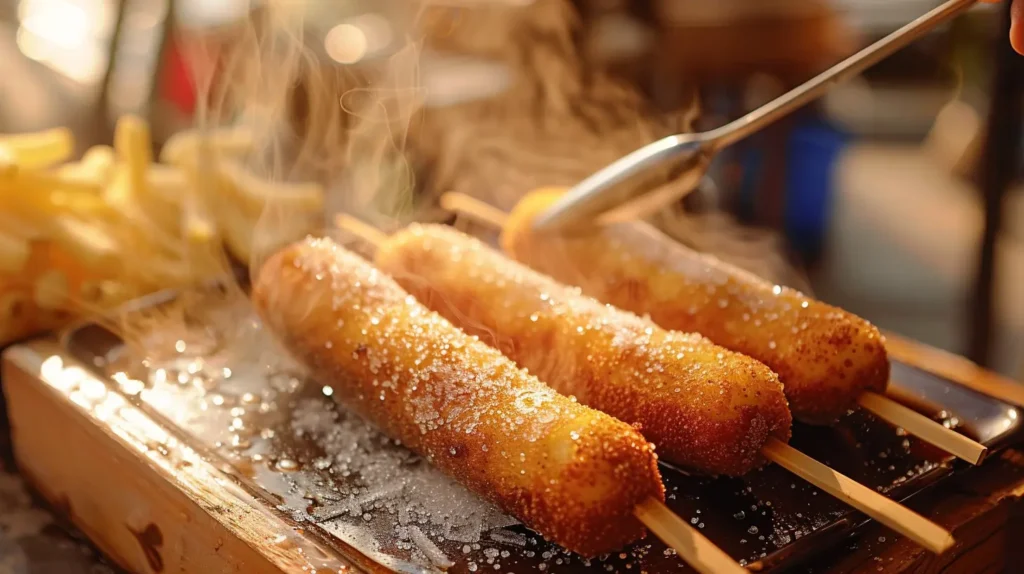
Midjourney Prompt: Korean corn dog just removed from hot oil, being rolled in a tray of white granulated sugar, steam rising, golden crispy exterior with visible sugar crystals forming, close-up macro shot on a Korean street food stall wooden counter, warm light, enticing food styling –ar 16:9 –v 6
Oil Temperature Mastery
Frying Korean corn dogs demands precision. Too cool (below 325F/165C) and the batter absorbs oil and becomes greasy before the exterior browns. Too hot (above 370F/188C) and the exterior burns before the filling heats through, leaving you with cold, unmelted cheese inside a dark brown exterior. The sweet spot is 350F (175C) for panko and 340F (170C) for potato coating.
Use a candy thermometer clipped to the pot. Don’t trust visual cues alone: oil that looks right can be 20F off in either direction. Between batches, let the oil return to temperature for at least 60 seconds before adding the next corn dog.
Leftovers and Reheating
Korean corn dogs do not microwave well: the exterior becomes soft and the cheese turns rubbery. The only acceptable reheating method is an air fryer at 350F (175C) for 5-6 minutes, which restores significant crispiness. You can also re-fry briefly in 375F oil for 90 seconds. Refrigerate for up to 2 days; freeze unfried, battered corn dogs for up to a month and fry directly from frozen (add 1-2 minutes to frying time).
Related Articles in This Series
- Copycat Raising Cane’s & Chick-fil-A Street Sauces
- Easy Elotes (Mexican Street Corn) 4 Ways
- Street-Style Loaded Fries: Regional American Variations
- Vietnamese Banh Mi You Can Make in 30 Minutes
- Homemade Soft Pretzels with Beer Cheese Dipping Sauce
- Authentic Jamaican Beef Patties from Scratch
- Late-Night Street Food Snacks Under 20 Minutes